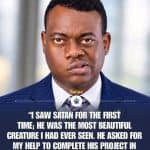

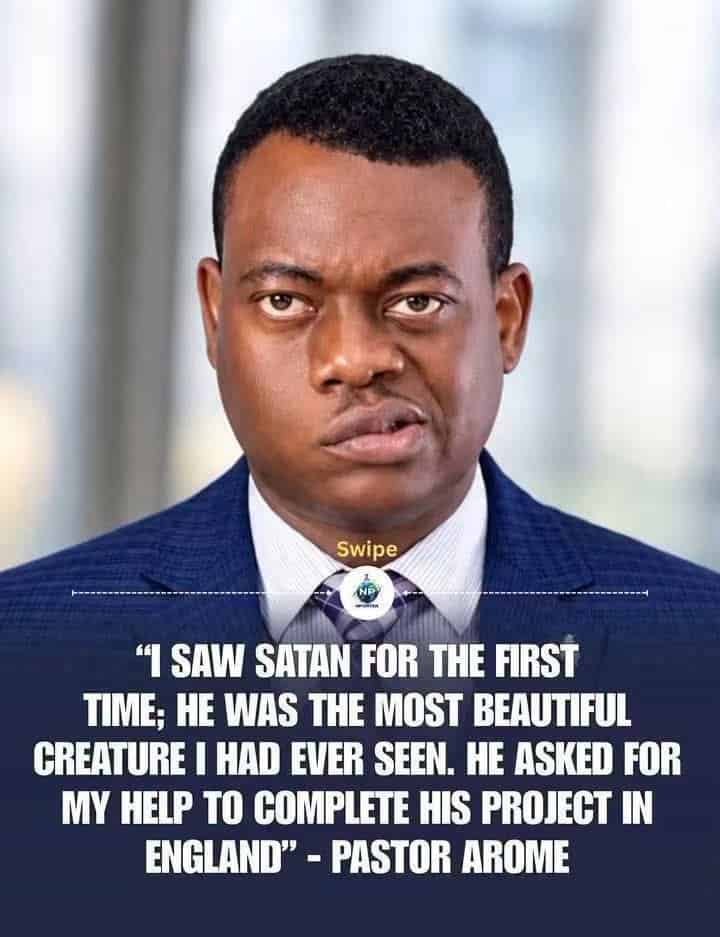
Recently, some Christians have taken to social media to criticize Apostle Arome Osayi over his claims about Satan, particularly his alleged encounter with the devil, whom he described as the most beautiful creature he had ever seen. Many have questioned his credibility, dismissed his account, and expressed disbelief at the story.
But their reaction raises a fundamental question: Why do people who believe in extraordinary supernatural events recorded in the Bible find it difficult to accept extraordinary supernatural claims made by a contemporary preacher?
Think about it.
The Bible is filled with accounts of events that, if narrated by someone today, would probably attract ridicule, scepticism, and demands for evidence from many of the same people who accept them as historical or supernatural truths.
We are told that Moses turned his rod into a snake and that he encountered God. We read about the parting of the Red Sea, water flowing from a rock, a donkey speaking, and the sun standing still. We hear of people being healed of diseases, the blind receiving their sight, the lame walking, and the dead being brought back to life.
Then there is the resurrection of Jesus, his ascension into heaven, and Paul’s account of being caught up into the third heaven. We are introduced to angels, demons, Satan as an angel of light, and a heavenly kingdom described in terms of streets of gold.
And, of course, there is the rather remarkable episode involving Peter’s sword and the ear of the high priest’s servant.
According to the Gospel of John, Peter drew his sword and cut off the right ear of a man named Malchus during Jesus’ arrest. Jesus then rebuked Peter, touched the injured man’s ear, and healed him (John 18:10โ11; Luke 22:49โ51).
Just imagine that happening in Nigeria today!
Someone cuts off another person’s ear during a confrontation. A religious leader allegedly picks it up, puts it back, and the ear is instantly restored. Videos of the incident flood social media. Would Christians just accept the story because someone said it happened? Or would many demand medical records, eyewitness testimony, video evidence, and an independent investigation?
The irony is that an event many would struggle to believe if reported today is already accepted by millions because it appears in a religious text they consider sacred.
The point is simply that fact that claims of extraordinary nature deserve the same critical examination as any comparable claim made today.
The same questions should apply to the biblical miracles, the healing crusades, claims of raising the dead, reports of angels appearing to people, and contemporary accounts of encounters with Satan.
If a preacher today claims to have raised someone from the dead, we should ask for evidence. If another claims to have seen an angel, we should examine the claim rather than accept it automatically. And if Apostle Arome Osayi claims to have encountered Satan, his account should be subjected to the same scrutiny. But we must also be willing to apply that standard to the supernatural narratives we have inherited.
You cannot consistently demand evidence from Arome Osayi while exempting the supernatural claims of your own religion from the same scrutiny.
This is where my argument comes in.
I am not saying that Arome’s claims are true. I am not asking anyone to believe him simply because he is a pastor. Rather, I am pointing out the inconsistency of accepting one set of supernatural claims while ridiculing another without applying the same standard of evidence to both.
If the appearance of a claim in the Bible is sufficient reason for you to accept it without independent verification, you must explain why a contemporary preacher’s testimony should automatically be treated differently. If, on the other hand, you believe that extraordinary claims require evidence, then that principle must apply regardless of who makes the claim or how sacred the story may be to you.
This is why I argue that Pastor Arome is simply riding a wave of supernatural beliefs that humanity has generated, nurtured, and sustained for thousands of yearsโa wave in which millions of people continue to swim.
He is not operating in a vacuum. He is speaking within an established worldview in which the existence of invisible beings, angels, demons, miracles, heaven, and hell is already accepted by many as fact. Within such a worldview, stories about encounters with supernatural beings can find ready audiences because the underlying assumptions have already been established.
The problem, therefore, goes beyond Pastor Arome. It concerns how human beings form beliefs, how religious traditions influence our understanding of reality, and why some people are willing to question new claims but reluctant to examine the assumptions they have held since childhood.
When people are taught what to believe without being equally encouraged to ask why they should believe it, familiarity can become a substitute for evidence. Tradition can become proof, and repetition can make extraordinary claims appear ordinary.
This is not unique to Christianity. The same critical questions should be directed at every religion, ideology, cultural tradition, and belief system that makes claims about reality. No belief should be immune to examination simply because millions of people accept it.
WHY CRITICAL THINKING MATTERS
This is precisely why Critical Thinking Education Initiative and other organisations like The Reflective Human, are committed to promoting a society that questions assumptions, examines claims, challenges superstitions, and embraces evidence-based reasoning.
Our mission is not to dictate what people should believe or to replace one unquestionable belief system with another. It is to encourage people to develop the intellectual independence to examine ideas, recognise contradictions, evaluate evidence, and change their minds when the facts demand it.
We want a society in which children are encouraged to ask questions rather than simply memorise answers; where adults can reconsider inherited beliefs without fear; and where public decisions are guided by reason and evidence rather than unverified supernatural explanations.
A society that cannot question its deeply held beliefs will struggle to identify and correct its errors. And a society that cannot correct its errors will struggle to make meaningful progress.
Nigeria needs more people who can distinguish between a claim and evidence for that claim, between personal conviction and demonstrable fact, and between what they have been taught to believe and what they have independently examined.
The objective is not merely to criticise religion. It is to cultivate a culture of intellectual honesty in which every claim, regardless of its source, is open to rational examination.
If we genuinely want a better society, we must stop treating questions as threats and start recognising them as essential tools for understanding our world.
We must learn to ask difficult questions, examine uncomfortable possibilities, and follow evidence wherever it leads.
Because believing something passionately does not automatically make it true. Neither does the fact that a story is ancient, popular, or sacred establish that the events described actually happened as narrated.
Let us stop defending beliefs simply because they are familiar. Let us start examining them because truth matters.
That is the society we are advocating for: a society that values reason over superstition, evidence over blind acceptance, and critical inquiry over unquestioning conformity.
A society where people are not merely taught what to think, but empowered to think critically.
Genesis Eririoma
Advocate of Critical Thinking in Africa
Critical Thinking Education Initiative
Welcome to the Critical Thinking Education Initiative Blog!
This blog is dedicated to sharing insights, research, and resources that promote critical thinking, rational inquiry, and evidence-based learning. Here, youโll find articles for students, educators, and the wider community that encourage analytical reasoning, questioning assumptions, and making informed decisions in everyday life.
We also highlight our programs, workshops, and free educational book distributions, keeping you updated on how we are empowering young minds and fostering independent thinking. Whether youโre a teacher, parent, student, or curious reader, our blog aims to provide practical tips, educational tools, and thought-provoking content to help build a more rational and informed society.