

FROM GODS AND MYTHS TO EVIDENCE AND DISCOVERY
For thousands of years humanity searched for answers in gods, myths, sacred stories, miracles, and superstition.
Every civilization attempted to explain the riddles of existence through supernatural beliefs. The origins of life, the movement of the heavens, disease, death, storms, droughts, and natural disasters were attributed to invisible powers beyond human understanding.
Yet the answers that transformed human civilization came from somewhere else. They came from observation, investigation, evidence, reason, and science. This is the story of how humanity journeyed from myth to knowledge, from superstition to discovery, and from unquestioning belief to critical thinking.
THE AGE OF GODS
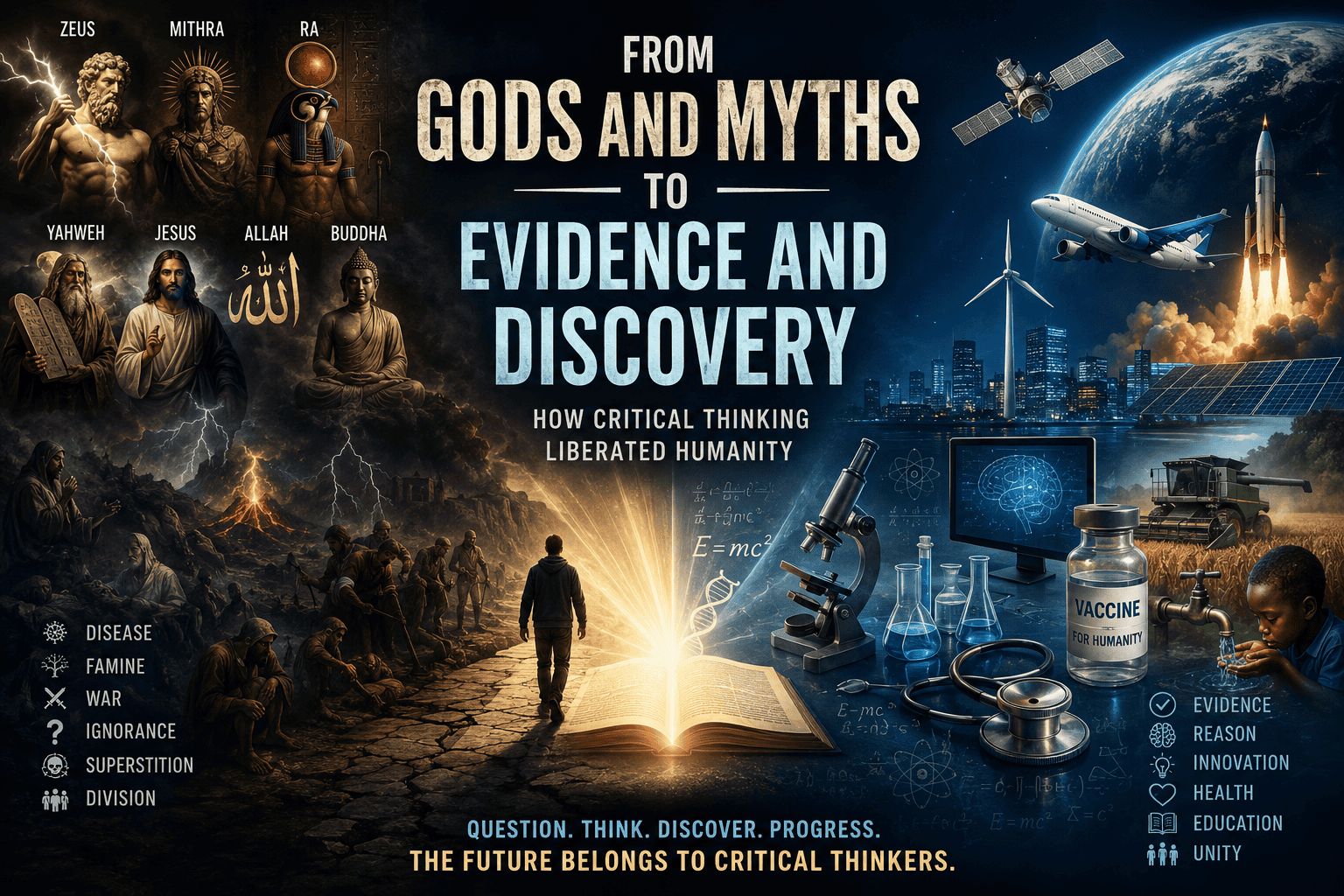
Throughout history, human beings created thousands of gods, spirits, prophets, and supernatural explanations to explain the mysteries of existence.
The Egyptians worshipped Ra, Osiris, Isis, Horus, Anubis, and countless others.
The Greeks looked to Zeus, Poseidon, Athena, Apollo, and Artemis. The Romans adopted and renamed many Greek deities, adding their own.
Persians revered Mithra. Norse societies worshipped Odin and Thor. Jews worshipped Yahweh. Christians worshipped Yahweh and Jesus Christ. Muslims worshipped Allah. Buddhists sought enlightenment through the teachings of Buddha.
Every culture believed it possessed special truths about the universe. Yet each culture arrived at different conclusions, worshipped different deities, and told different stories about reality.
In spite of these differences, all human societies faced the same questions: Why do diseases occur? Why do children die? Why do earthquakes happen? What causes droughts, eclipses, lightning, and plague? How did the universe begin? What are the stars?
Humanity looked to the supernatural for answers because it lacked the tools to discover natural explanations. In a world without microscopes, telescopes, chemistry, geology, medicine, or modern physics, myths filled the gaps in knowledge.
WHAT THE GODS NEVER DELIVERED
For millennia people prayed for cures, protection, rain, harvests, fertility, prosperity, and victory.
Temples were built. Sacrifices were offered. Pilgrimages were undertaken. Priests, prophets, shamans, and holy men claimed access to divine wisdom, yet epidemics continued, infant mortality remained high, and life expectancy remained short.
Famine devastated populations. Natural disasters struck without mercy. The gods of one culture proved no more effective than the gods of another at solving humanity’s most pressing problems.
No deity revealed germ theory. No sacred text discovered antibiotics. No prophet invented the telescope. No miracle produced electricity. No prayer built a computer. No revelation launched a satellite.
No divine messenger explained DNA, vaccination, planetary motion, or the causes of disease. Human progress came not from divine intervention but from human investigation.
The advances that transformed civilization emerged when people began studying nature itself rather than relying on supernatural explanations.
Read Also: Critical Thinking Awareness
THE REVOLUTION OF EVIDENCE
Science introduced a revolutionary idea:
Claims should be tested, beliefs should follow evidence, ideas should be questioned, and authority should not be immune from scrutiny.
This simple method transformed civilization; unlike faith, science does not ask people to believe without evidence. It encourages doubt, welcomes criticism, and constantly tests its own conclusions.
Science revealed that disease is caused by microbes, not curses. Lightning is electrical discharge, not divine anger. Earthquakes result from tectonic forces, not supernatural punishment. The Earth is not the center of the universe. The stars are distant suns.
Human beings evolved through natural processes that took immense spans of time. Nature follows discoverable laws that can be studied, understood, and applied.
Every major scientific breakthrough expanded humanity’s understanding of reality and reduced the domain of ignorance.
HOW SCIENCE SAVED HUMANITY
Science gave us:
Vaccines that prevent disease. Antibiotics that cure infections. Modern surgery. Electricity. Safe drinking water. Air travel. Computers. The Internet. Space exploration. Modern agriculture. Medical imaging. Weather forecasting. Modern sanitation etc.
All these innovations dramatically improved human life. Diseases that once killed millions can now be prevented or treated. Average life expectancy has increased dramatically compared to previous centuries.
Child mortality has fallen. Communication across continents now occurs instantly.
Humans have walked on the Moon, mapped the human genome, and explored distant planets using machines built through scientific knowledge.
SCIENCE IS A HUMAN ACHIEVEMENT
The story of science is not the story of one civilization, race, religion, or continent. It is the collective achievement of humanity.
Ancient Egyptians developed mathematics, engineering, medicine, and astronomy that impacted later civilizations. Their understanding of geometry contributed to some of the most remarkable structures of the ancient world.
African societies independently developed sophisticated iron-working technologies that transformed agriculture, trade, and craftsmanship. Great centers of learning such as Timbuktu preserved and advanced knowledge in mathematics, astronomy, medicine, and philosophy.
Today, African scientists, engineers, doctors, inventors, and investigators continue to contribute to medicine, telecommunications, agriculture, renewable energy, and technological innovation across the globe.
Whether a discovery is made in Cairo, Timbuktu, Lagos, Beijing, Delhi, London, or New York, it becomes part of humanity’s shared knowledge.
Science belongs to no nation, tribe, religion, or race. Its method is universal: observe, test, learn, and improve.
Every major increase in human life expectancy, health, communication, transportation, and technological capability has been built upon evidence, experimentation, and critical inquiry.
The modern world is the product of human curiosity applied through reason.
THE COST OF SUPERSTITION
Throughout history, dogma and superstition have often obstructed progress.
People have been persecuted for questioning accepted beliefs.
Books have been banned. Ideas have been censored.
Wars have been fought over competing religious claims.
Scientific discoveries have been resisted because they challenged sacred traditions.
When beliefs are protected from criticism, ignorance survives.
When questions are forbidden, progress slows.
When evidence is ignored, dangerous ideas persist.
History shows that societies advance most rapidly when ideas can be challenged, tested, and revised in light of new evidence.
Critical thinking does not require rejecting every tradition or belief. It requires evaluating claims according to evidence rather than authority, fear, custom, or wishful thinking.
Any society that values evidence is better equipped to solve problems than one that relies upon faith alone.
The greatest advances in human welfare have come from open inquiry, free investigation, and the willingness to change our minds when the evidence demands it.
THE FUTURE BELONGS TO CRITICAL THINKING
Humanity’s greatest achievements came not from accepting claims without evidence but from asking difficult questions.
Critical thinking is not the enemy of wonder.
It is the path to understanding.
The universe remains huge, mysterious, and awe-inspiring. Yet every generation has pushed back the borders of ignorance through curiosity and discovery.
The option before humanity remains the same:
Myths or evidence. Dogma or inquiry. Superstition or discovery.
The future will be built not by those who claim to possess all the answers, but by those willing to question, investigate, learn, and follow the evidence wherever it leads.
Think critically. Question boldly. Demand evidence. Choose reason.
“Science has no homeland. Knowledge belongs to humanity.”